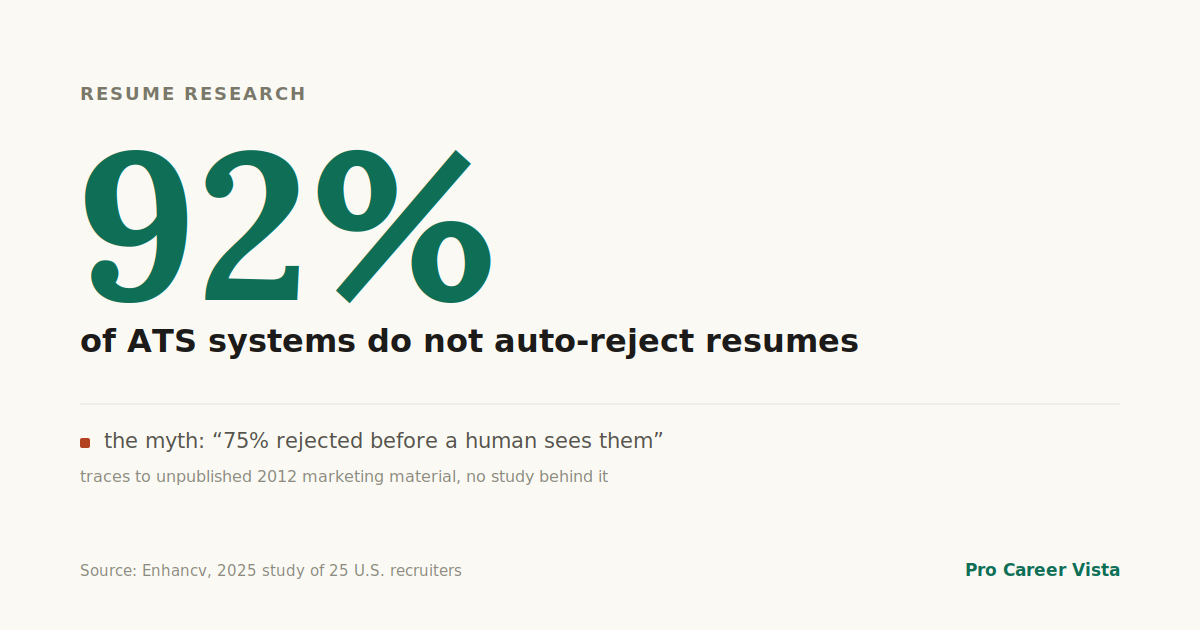
Quick answer: The claim that 75% of resumes are rejected by applicant tracking systems before a human sees them has no credible research behind it. A 2025 study of 25 U.S. recruiters found 92% do not auto-reject resumes at all. The real reasons resumes go unanswered are application volume, weak formatting, and vague achievements, not a hidden algorithm.
If you've applied to dozens of jobs without hearing back, you've probably read that a robot rejected your resume before a human ever saw it. That claim shapes how most job seekers write, format, and submit their applications. It also happens to be largely untrue, and understanding why changes what you should actually fix.
The 75% rejection myth, and where it came from
Direct answer: The 75% ATS rejection statistic traces to unpublished 2012 marketing material from a company that no longer exists, and the best available recent research found the opposite: 92% of recruiters say their systems don't auto-reject resumes at all.
The statistic that circulates most widely online claims that three out of four resumes get rejected by applicant tracking systems before reaching a recruiter. It traces back to 2012 marketing material from a now defunct resume optimization company, and no dataset or methodology behind it was ever published.
A more recent and far better documented study tells a different story. In late 2025, Enhancv interviewed 25 U.S. based recruiters across technology, healthcare, finance, manufacturing, and several other sectors, using platforms including Workday, iCIMS, Greenhouse, and LinkedIn Recruiter. Ninety two percent said their systems do not automatically reject resumes based on formatting, content, or design.
Ninety seven point eight percent of Fortune 500 companies do use some form of ATS, but using the software and configuring it to auto-reject candidates are two different things. In practice, the recruiters in this study reported using knockout questions, not content scoring, as their only true form of automatic filtering, typically for things like work authorization or required certifications rather than resume quality.
The real bottleneck is simpler and less dramatic than a hidden algorithm. Popular roles routinely draw between 400 and 2,000 applicants, and recruiters realistically review only the top 20 to 50 of them. That's a volume problem, not a formatting trap.
What actually happens in the first pass
Direct answer: Recruiters spend an average of six seconds on an initial resume scan, focused almost entirely on name, job titles, employment dates, and education, before deciding whether a resume earns a closer look.
If a resume isn't being auto-rejected by software, what determines whether it survives the first human look?
The often quoted "six second resume rule" comes from a 2012 eye tracking study by TheLadders. Recruiters in that study spent an average of just six seconds determining whether a resume was worth a closer look, a striking contrast to the four minutes recruiters said they typically dedicated to each application when surveyed separately. Roughly eighty percent of that six seconds went toward six specific details: name, current and previous job titles, employment dates, and education.
That gap between six seconds and four minutes isn't a contradiction. It describes two separate stages. The six second scan is triage, deciding whether a resume is even in the right category. The longer review happens afterward, for resumes that clear that first filter.
More recent research supports a similar two stage pattern with larger numbers. An August 2025 study by InterviewPal analyzing over 4,000 anonymized resume reviews across 312 recruiters found a median total review time of about a minute and a half, with most of that time spent verifying specific, quantified results rather than reading prose. Independent eye tracking work by recruiter Jan Tegze found a wider average range, between 17 and 46 seconds per resume, depending heavily on how dense and detailed the document was.
The practical implication is consistent across all of these studies: your name, title, dates, and top line achievements need to be instantly visible, because that's genuinely all a first reader is looking for.
What separates resumes that get a second look
Direct answer: Once a resume survives the first scan, formatting quality, quantified achievements, and appropriate length become the deciding factors, not keyword density or any hidden scoring system.
Once a resume survives the initial scan, different factors take over.
Formatting still matters, just not the way people assume. It's not that software silently discards resumes with the wrong font. Seventy three percent of hiring managers in one industry survey said they reject candidates specifically over poor formatting, meaning layout problems end a candidate's chances during the human review, not an automated one.
Quantified results carry real weight. Resumes that include specific, measurable outcomes were found to have up to a 40% higher chance of leading to an interview compared with resumes that describe responsibilities in general terms.
Length is more forgiving than most advice suggests. A widely cited ResumeGo study had nearly 500 recruiters and hiring managers screen close to 8,000 resumes. It found recruiters were 2.3 times more likely to prefer two page resumes over one page versions, rating their ability to summarize a candidate's full background 21% higher on average, and spent more than four minutes reviewing two page resumes compared with under two and a half minutes on one page versions. The advice to compress every resume to a single page, regardless of experience level, isn't well supported by the data.
What this means for how you should actually write your resume
Direct answer: Front load your top line achievements, replace duty statements with quantified results, and let resume length follow your actual experience level rather than a fixed one page rule.
This is where research needs to translate into a decision, not just a set of statistics. Based on the patterns above, three priorities matter more than the rest:
1. Front load your top line facts. Current title, most recent employer, and one or two headline achievements should be visible without scrolling, since that's what the earliest scan is built around.
2. Replace duty statements with results. "Managed a sales team" tells a reviewer nothing that survives a fast read. "Led a six person sales team to a 34% year over year revenue increase" does the work the six second scan and the longer review both reward.
3. Let length follow experience, not a rule of thumb. Someone with three years of experience padding to two pages looks thin. Someone with twelve years of experience cramming onto one page loses the detail that the data shows recruiters actually value.
None of this requires guessing at what an invisible algorithm wants. It requires writing for the actual human being who will spend somewhere between six seconds and four minutes deciding whether you're worth a phone call.
If reworking your resume around these findings feels like more than you want to take on alone, Pro Career Vista's resume writing services are built around exactly this kind of data.
The bigger pattern behind the data
Direct answer: Across every study cited here, resume rejection is consistently explained by clarity, specificity, and application volume, not by an algorithm silently filtering out qualified candidates.
Across every study cited here, from the ATS rejection research to the resume length findings, the same theme repeats: the popular explanation for resume rejection blames an algorithm, and the actual explanation is almost always about clarity, specificity, and volume. Job seekers who understand that distinction stop optimizing for a machine that mostly doesn't exist in the form they imagine, and start optimizing for the recruiter who does.
This analysis draws on the most recent and methodologically transparent studies available, including 2025 and 2026 research from Enhancv, InterviewPal, ResumeGo, and independent eye tracking data, rather than repeating figures with no traceable source.
Kaleem Ullah
Certified Professional Resume Writer (CPRW) | Founder, Pro Career Vista
Kaleem Ullah is a Certified Professional Resume Writer with experience writing resumes, cover letters, and LinkedIn profiles for professionals across a range of industries. Before founding Pro Career Vista, he worked as a freelance resume writer on Upwork, building a track record that informs the research based, practitioner level advice published here.